1. Federalism Conflict & Supreme Court Precedent
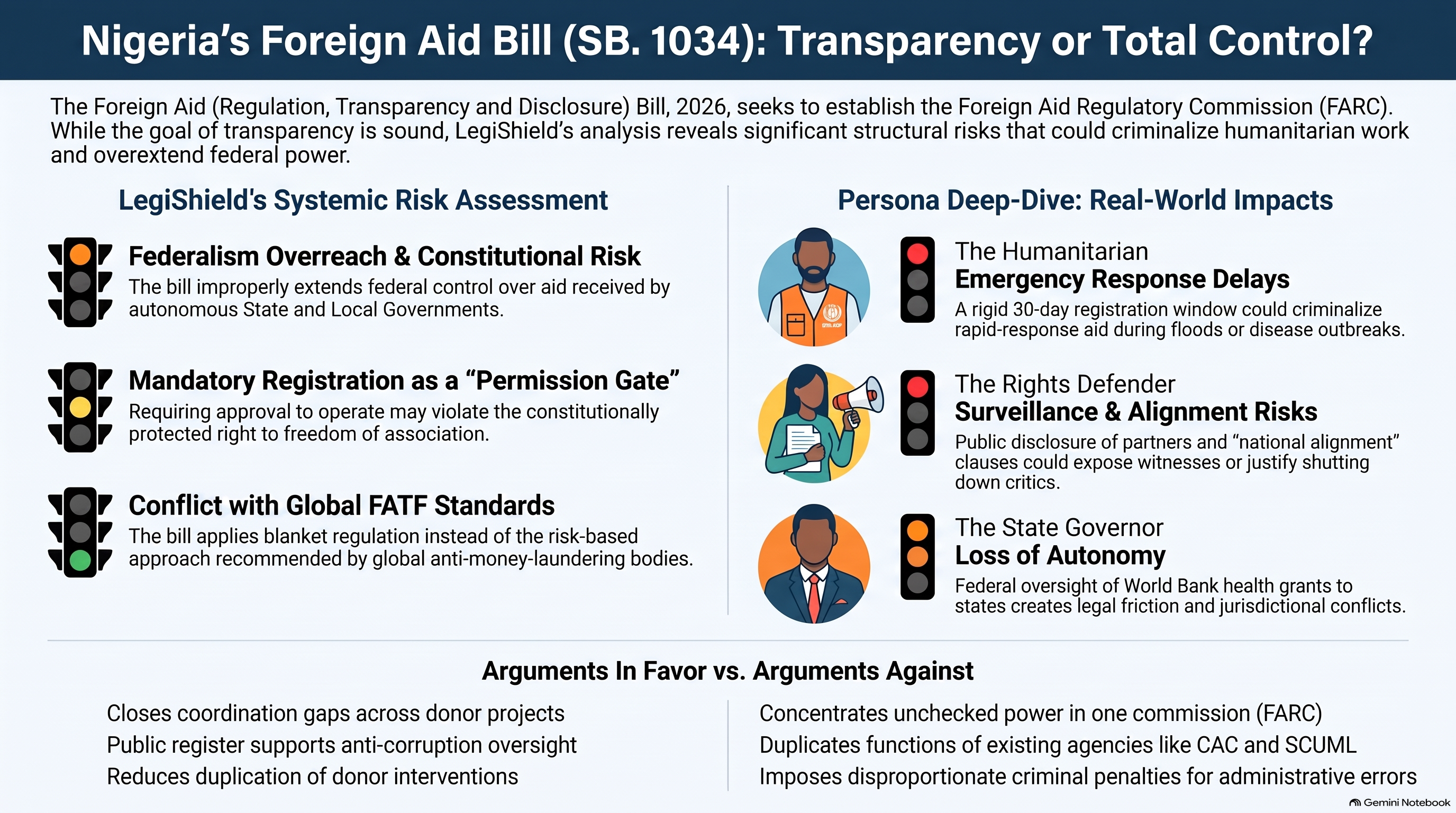
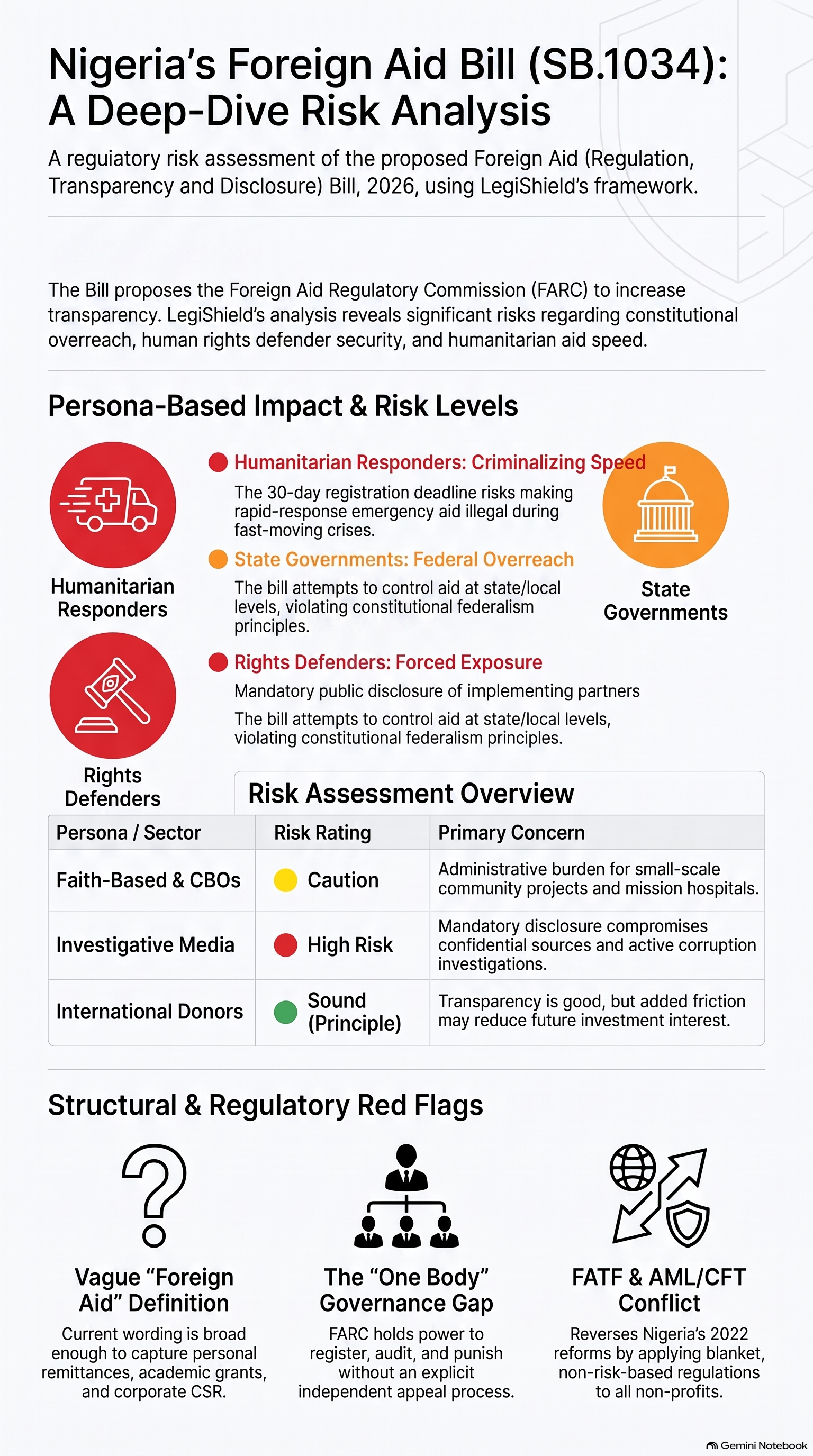
SB.1034 reaches into aid received directly by State and Local Governments. In Nov 2024, the Supreme Court nullified the National Lottery Act for similar federal overreach into non-exclusive domains.
A LegiShield Policy X-Ray evaluating the structural mechanics, stakeholder impacts, and regulatory trade-offs of the proposed Foreign Aid Regulatory Commission (FARC).
Sound objective, but fatal structural mechanism.
Comprehensive overview of SB.1034, FARC mandate, and civic space implications.
A 2026 Nigerian Senate bill sponsored by Sen. Ibrahim Hassan Dankwambo seeking to regulate, coordinate, and track all foreign aid, grants, and international donations received in Nigeria.
The proposed Foreign Aid Regulatory Commission (FARC), an omnibus federal body granted unchecked power to register recipients, inspect operations, conduct audits, and issue sanctions.
Missing the mandatory 30-day registration deadline carries minimum β¦5M fines or up to 5 years imprisonment for individuals, and β¦20M fines plus license revocation for corporate bodies.
We grade policy provisions using a plain-English risk spectrum to highlight sound intentions vs. fatal design flaws.
Policy objective is fine, necessary, or well-supported by sound evidence.
Real risk exists requiring revision, but not fatal on its own.
Structural problem likely to cause real harm or constitutional conflict if unaddressed.
Fatal flaw. Likely to be struck down in court or cause severe real-world harm.
SB.1034 reaches into aid received directly by State and Local Governments. In Nov 2024, the Supreme Court nullified the National Lottery Act for similar federal overreach into non-exclusive domains.
Making registration mandatory under criminal penalty transforms reporting into a licensing requirement, threatening constitutionally protected freedom of association.
FARC investigates, adjudicates, and sanctions without explicit judicial appeal mechanisms, violating basic separation of powers and due process principles.
Strict 30-day deadlines do not account for flood, epidemic, or displacement crises. First responders distributing emergency funds face up to 5 years in prison for paperwork delays.
Explore all multimedia assets analyzing the policy mechanics and human stakes of SB.1034.
How a rigid 30-day paperwork window collides with immediate life-saving emergency response during floods and disease outbreaks.
Balancing legitimate state transparency with constitutional federalism and state government autonomy.
Unpacking section 11 "national alignment" tests, vague definitions, and unchecked ministerial rulemaking.
Why administrative reporting delays risk being converted into criminal convictions for frontline workers.
A detailed examination of why 90 civil society groups are urging the National Assembly for immediate withdrawal.
High-level synthesis of FARC powers, financial reporting mandates, and alternative inter-agency fixes.
Audio investigation into operational bottlenecks, emergency response freezes, and criminal penalty exposures.
Discussion with legal experts on freedom of association, FATF compliance, and civil society resistance ahead of 2027.
Slide 001: Unpacking Nigeria's Foreign Aid Bill (SB. 1034)
Slide 002: Intent vs Reality Diagnostic Legend
Legal analysis grounded in practical scenarios across Nigerian society.
Comparing the legitimate public policy arguments in favor against key risks.
Why proponents advocate for SB.1034
Structural risks flagged by civil society
Get the complete 12-slide high-resolution diagnostic deck evaluating structural mechanics, FATF compliance, constitutional federalism risks, and recommended statutory amendments.
What it does, why it's controversial, and what it means for you β broken down plainly
Nigeria's Senate is considering a law that would create a powerful new government office to track every dollar of foreign aid entering the country β who receives it, how it's spent, and whether it's playing by the rules.
The goal is good. Transparency around foreign aid is genuinely overdue.
The design is the problem. As written, this bill hands one office the power to register, inspect, audit, and punish β including the power to shut organisations down β with no independent check on those decisions.
Recommendation: Preserve the transparency objective; rebuild the mechanism around ex-post disclosure, inter-agency data-sharing with CAC, SCUML, and NFIU, and risk-based referral to existing enforcement bodies β rather than establishing a new, unchecked licensing regime.
Sponsor: Sen. Dankwambo, Ibrahim Hassan (Gombe North)
A BILL FOR AN ACT TO PROVIDE FOR THE REGULATION, COORDINATION, TRANSPARENCY AND DISCLOSURE OF FOREIGN AID, GRANTS AND DONATIONS RECEIVED IN THE FEDERAL REPUBLIC OF NIGERIA; TO ENSURE ACCOUNTABILITY IN THE UTILIZATION OF SUCH AID; AND FOR RELATED MATTERS, 2026 (SB. 1034).
PART I β OBJECTIVES AND APPLICATION
1. Objectives of the Act
The objectives of this Act are toβ
(a) establish a comprehensive framework for the regulation and coordination of foreign aid in Nigeria;
(b) ensure transparency and accountability in the receipt and utilization of foreign aid;
(c) promote alignment of foreign aid with national development priorities;
(d) prevent misuse, diversion, or duplication of foreign-funded projects; and
(e) enhance public access to information on foreign aid.
PART II β ESTABLISHMENT OF THE FOREIGN AID REGULATORY COMMISSION
3. Establishment of the Commission
(1) There is established a body to be known as the Foreign Aid Regulatory Commission (FARC).
(2) The Commission shall be a body corporate with perpetual succession and a common seal.
PART V β OFFENCES AND PENALTIES
12. Offences
A person or entity commits an offence if itβ
(a) fails to register foreign aid;
(b) provides false or misleading information;
(c) diverts or misuses foreign aid; or
(d) obstructs the Commission in the performance of its functions.
13. Penalties
(1) An individual convicted under this Act is liable toβ
(a) a fine not less than β¦5,000,000 or imprisonment for a term not exceeding 5 years, or both.
(2) A corporate body is liable toβ
(a) a fine not less than β¦20,000,000; and
(b) suspension or revocation of operational license.