Your Reform Legacy Needs Proof
Winning Needs Forensics.
Mandatory Briefing Video
LegiShield's overview of the system and its risks.
Stadiums are Theatre.
The Pipeline is the Verdict.
While you watch the rallies, your rival is watching the hidden points where results can be delayed, swapped or changed. That is the weak spot in modern democracy.
We have mapped the hidden path between the paper ballot and the results website. Everything you see here comes from the Iceberg Doctrine.
"Don't chase the crowd. Chase the data nodes."
— Ade Atobatele, CEO LegiShield
The Architecture of Trust: System Explainer
Mandatory Disclaimer
LegiShield is a technology consultant, not a law firm. This material is for planning only.
The BVAS Node
Where the first record is made.
The RATECH Layer
Unregulated people who handle results in between.
Backend Sync
Where mismatched server data breaks trust.
The Origins of the Siege.
To win the future, we must understand what went wrong in the past ten years.
Historical Origins Briefing
How the weak points in the results process grew over time.
Odinga Precedent
Kenya's Supreme Court cancels a presidential election because the process was flawed.
Abeokuta Blueprint
A meeting at the Olusegun Obasanjo Presidential Library maps the risk where results pass from the polling-unit device to the server (as told in the book).
Osun Divergence
In open court, it is proven that the machine's data and the server's data do not match.
The Forensic Filing
On 1–2 March 2023, the petitioners’ lawyers ask to inspect BVAS devices. On 3 March, the Court of Appeal allows a forensic inspection.
Optional Ruling
A court rules that sending results online is "optional". Trust in elections falls across the country.
Statutory Shield
Sending results online becomes law. But Section 60(3) does not say what "communication failure" means.
The Interactive
Stare Decisis Vault.
"Technology evidence is now part of every election petition."
From the 2023 inspection orders to the Electoral Act 2026, these court decisions now set the rules for BVAS and IReV evidence. Each has a neutral summary and a citation.
Hardware Inspection Right
They said: "Hardware access is a myth."
Court of Appeal, 3 March 2023: allowed a digital forensic inspection of BVAS devices. This is now Section 149, Electoral Act 2026.
The Ajaka Order
They said: "Appeals will stall your window."
Supreme Court, 14 March 2024: brought back a tribunal’s order to inspect BVAS devices (Ajaka v. Ododo).
"Best Evidence" Doctrine
They said: "Backend reports settle accreditation."
Supreme Court, May 2023: the BVAS device is the main proof of who was accredited to vote (Oyetola v. INEC).
From Guideline to Statute
They said: "Transmission is optional."
In 2023, courts said sending results online was optional under the 2022 Act. Section 60(3) of the Electoral Act 2026 now makes it a must.
The Tendering Rule
They said: "Just put the devices in evidence."
Edo 2024: BVAS devices handed in by lawyers from the bar, without consent, were removed from the record. The Supreme Court agreed on 10 July 2025.
The Evidentiary Floor
They said: "Methodology is a technicality."
Electronic records need a proper foundation under Section 84 of the Evidence Act before a court accepts them (Kubor v. Dickson, SC 2013; Evidence (Amendment) Act 2023).
Stare Decisis Vault Briefing
Key court rulings, the right to inspect devices, and evidence rules.
Is Your Campaign Vulnerable to a Digital Coup?
Run the 60-Second LegiShield Compliance Check.
NIGERIANS SAVE YOUR DEMOCRACY!
The Roadmap Starts Here.
BUY WEAPONISING ELECTIONS ON AMAZON.
2027 election petitions must be filed within 21 days of the result. Teams that have this book will file petitions that last. The time to prepare is now.
This book gives your whole team one trusted source, with checked citations and a clear forensic starting point. It is the main record behind every other tool we offer. Any team handling an important petition needs it.
Inside The Forensic Dossier.
The Digital Pipeline
Maps the hidden path between the paper ballot and the results website. Shows the RATECH weak spot and the 'Two CTCs' problem seen in open court.
The Forensic Doctrine
Tells the story of the 72-hour race to beat the server wipe. Explains the six court decisions that shaped technology evidence before the Electoral Act 2026.
The Arbitrator is the Villain
A study of how elections are captured across 54 African countries. Shows how the "communication failure" excuse is used as a weapon around the world.
The Modes of Defeat
The 2027 threat map, from Mode 0 to Mode 11, with the new 2026 Modes 1-B, 1-C and 1-D. Up-to-date warnings, including the Constitutional Delayed Detonator and the Defection Highway.
Test yourself: can you spot the modes of defeat?The Silicon Gowns
The Decagons of Forensic Strategy. Meet the new kinds of lawyers fighting for the results process: Shields, Spears and Filters.
Legislation & Checklists
Contains the IETCC Model Bill (Appendix C; check the updated Model Bill Package before it goes to the legislature) and the 29-item Post-Election Verification Checklist.
Meet Dr. Haruna Obi: Your 24/7 AI Forensic Witness
Every book, training and battle instrument connects here. Dr. Haruna Obi AI is your team's forensic election research tool, open 24/7.

Dr. Haruna
AI Engine
- Built on ten years of research into African election court cases.
- Quick answers on inspection law, past cases and evidence. Your own lawyers still write the final documents.
- Real-time querying of the Stare Decisis Vault.
- Updated daily with the latest election developments.
THE ICEBERG DOESN'T CARE
ABOUT YOUR RALLIES.
Stadiums are theatre. Forensics is the verdict. Gather crowds if you must. But if you don't control the data, you have already lost.
No access to Dr Haruna Obi, our AI expert? You can still protect the vote with our Battle Bundles, built for each role.
Find Your Battle Bundle.
The Principal's Shield
Outcome: You are ready for a midnight result, because you protected the data first.
- • The BVAS Battle (Master IP)
- • Campaign Legal Intelligence Briefing
- • Election Legal Readiness Audit
- • Declaration-Night Scenario Planner Kit
- • War Room Manual
- • OSINT Verification Guide for Election Evidence
- • Election Data Protection Toolkit
The Forensic Arsenal
Outcome: A petition that survives the first 72 hours, when data is most at risk.
- • The BVAS Battle (Master IP)
- • Election Petition Playbook
- • Day-One Application Template Pack
- • Litigation Prayers Bank
- • Annotated Case Digest
- • OSINT Verification Guide for Election Evidence
- • Pre-Election Application Template Pack
- • Judicial Bench Book (free bonus)
The Architect's Shield
Outcome: Your legacy as the author of Nigeria's first truly strong election law.
- • The BVAS Battle (Master IP)
- • Model Bill Validation Dossier
- • Governance Training Curriculum
- • Model Bill Package (free bonus)
- • Policy Brief Series (free bonus)
- • Judicial Bench Book (free bonus)
- • West Africa Assessment Framework (free bonus)
The Integrity Watch
Outcome: Observer reports that become forensic evidence a court can accept.
- • The BVAS Battle (Master IP)
- • IReV Audit Methodology
- • OSINT Verification Guide for Election Evidence
- • Governance Training Curriculum
- • Election Data Protection Toolkit
- • Observer Deployment Guide (free bonus)
The Historical Base
Outcome: Data you can cite, showing how power has shifted in West Africa.
- • The BVAS Battle (Master IP)
- • Annotated Case Digest
- • Case Study Dataset (free bonus)
- • West Africa Assessment Framework (free bonus)
- • Policy Brief Series (free bonus)
The Regional Blueprint
Outcome: A technical plan for running elections that works across countries.
- • The BVAS Battle (Master IP)
- • Governance Training Curriculum
- • IReV Audit Methodology
- • Model Bill Validation Dossier
- • West Africa Assessment Framework (free bonus)
- • Policy Brief Series (free bonus)
The Battle Instruments.
Nothing in this bundle for that phase. Try another phase or bundle.
The Principal’s Shield
Everything a campaign needs to protect, capture and prove its votes.
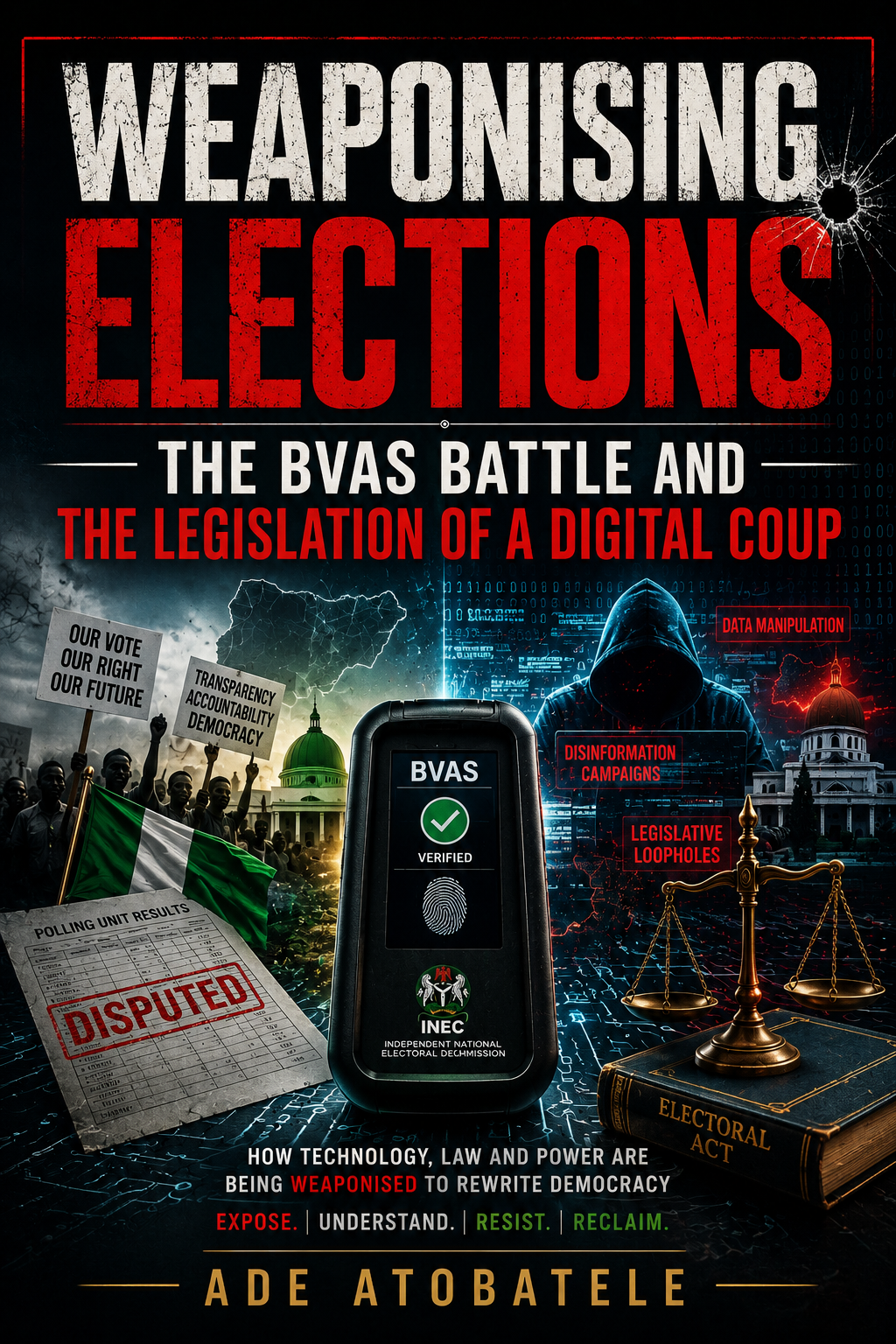
Weaponising Elections: The BVAS Battle and the Legislation of a Digital Coup
The forensic story of how Nigerian elections are won and lost between the polling unit and the results website.
Campaign Legal Intelligence Briefing
2027 Elections
Know the legal traps before they close on your campaign.
Election Legal Readiness Audit
Compliance Audit Wizard
Score your campaign’s legal readiness before your rivals find the gaps.
Declaration-Night Scenario Planner Kit
Practise for the midnight result before it happens.
War Room Manual
The 72-Hour Evidence Protocol
The first 72 hours after polls close decide what you can prove.
OSINT Verification Guide for Election Evidence
Turn social-media claims into evidence that holds up.
Election Data Protection Toolkit
DPIA & Privacy Notices (NDPA 2023)
Collect evidence lawfully, protect your people.
The Cross-Reference Map.
See how the 20 Battle Instruments fit into the 6 Bundles. Each bundle is built for a different role.
The Masterclasses.
Five self-paced courses, built from the book and checked against current law. Every module has a quiz, and you get a certificate when you finish. The free Judicial Bench series is below.
The Litigation Playbook
Advocacy for BVAS/IReV Election Petitions
Five modules on arguing about technology evidence, for lawyers on either side.
- 5 modules, 27 lessons with video briefings
- Quizzes after each module
- Completion certificate
For: Election petition counsel and chambers associates
Election War-Room Certification
Train your team for pre-election checks, election day and the 72 hours after.
- 4 modules, 20 lessons
- Interactive checkpoints and quizzes
- Completion certificate
For: Campaign war-room staff, agent supervisors, observer coordinators
The Iceberg Doctrine
Election Forensics & Data Science
From raw election data to evidence that holds up.
- 6 modules, 33 lessons
- Method walkthroughs and quizzes
- Completion certificate
For: Data teams, observers, researchers, journalists
The Oversight Deficit
Comparative Electoral Governance for Policymakers & Donors
Why no one outside is checking election technology across most of Africa, and how to fix it.
- 5 modules, 35 lessons
- Stress-test questions and quizzes
- Completion certificate
For: Legislators, committee staff, development partners, policy institutes
Credible Internal Elections
Governance for Associations, Professional Bodies and Parties
Run elections your members will trust.
- 6 modules, 23 lessons
- Quizzes, a practice scenario and a readiness checklist
- Completion certificate
For: Professional bodies, associations, unions, cooperatives, alumni and student bodies, party organs
Educational material, not legal advice. Dr. Haruna Obi is a fictional presenter.
Confidential 1-On-1 Election Consultancy.
For candidates, campaign leaders and chief lawyers who cannot afford surprises. LegiShield gives direct, expert technical advice and sets up a war room built only for your campaign.
Executive Briefing Preview
One-on-one help to protect your election.
State & Constituency Threat Modeling
Custom forensic checks that map the weak points in BVAS, RATECH and result sending in your area.
Direct Principal Advisory
Private one-on-one strategy sessions with LegiShield's senior team to review your plans and how you collect evidence.
War Room Architecture Deployment
A ready-made setup to collect results live, log network delays by location, and save evidence fast within the key 72-hour window.
Litigation Technical Support
Technical support for your legal team on inspection and evidence under Section 149, plus evidence mapping and expert analysis. Your own lawyers prepare and file every court document. We work for one side per contest.
The Judicial Bench Pleading Video Series.
A neutral five-module course on BVAS, IReV and technology evidence under the Electoral Act 2026. It is free to judges through the National Judicial Institute. It is also published openly, so every party and lawyer sees exactly what judges see. It is presented by Dr. Haruna Obi, a fictional virtual expert witness.
Judicial Module 1 Preview
Introducing Dr. Haruna Obi, virtual expert witness.
Modules 1–5 Open Access
Judges, lawyers and the public — same terms- 5 modules, 25 lessons with video briefings; quizzes and completion certificate.
- We sell nothing to serving judges. The course is never bundled with, or tied to, any purchase.
- Neutral content: no taking sides, nothing for any one party, and no contact about ongoing cases.
Nine Voices. One Iceberg.
Four voters and five professionals face the question this book answers: what sits beneath the result on the screen? New episodes come out until the 2027 elections.
Characters are fictional and AI-generated. Not legal advice.


Following the story?
Tell us who you follow and what you want next. Two minutes.
Join The Community!
Don't fight alone. Connect with other planners, lawyers and observers who are protecting the results process.
Live Virtual Rooms
Join our live online rooms for in-depth forensic talks, Q&A with the LegiShield team and the Silicon Gowns, and group discussions.
Tactical Comms
Get quick alerts on breaking election news, tribunal updates and new risks to the results process, in our WhatsApp group.
Intel Dispatch
Get the free Currency Bulletins and in-depth analysis whenever the law changes.
Frequently Asked Questions.
Plain answers about Nigeria's 2027 elections, BVAS, IReV and election petitions under the Electoral Act 2026. This is general information, not legal advice.
What is the BVAS Node in Nigerian election cases?
BVAS stands for Bimodal Voter Accreditation System. It is the device at the polling unit that checks voters in and sends the result. The Supreme Court treats the BVAS device as the main proof of who was accredited to vote (Oyetola v. INEC, 2023). Section 149 of the Electoral Act 2026 sets the rules for inspecting election materials.
What is the RATECH Layer?
RATECH means Registration Area Technical Support Staff. They are the people and technical steps that polling-unit data passes through before it reaches the main server. This creates points where results could be changed by hand.
How does Section 149 of the Electoral Act 2026 let you inspect election materials?
Under Section 149 of the Electoral Act 2026, a party to an election petition can ask the tribunal for an order to inspect election materials, including BVAS devices. If the Commission does not obey, the law adds a step where it must explain why (s.149(3)). Courts first allowed digital forensic inspection of BVAS devices on 3 March 2023, under s.146 of the 2022 Act. Courts have not yet finally decided whether backend server logs are covered. Petitions must be filed within 21 days of the result.
How does Dr. Haruna Obi AI help legal teams with election petitions?
Dr. Haruna Obi AI is a forensic research assistant. It is built on ten years of research into African election court cases. It answers questions on inspection law and past cases, searches the Stare Decisis Vault, flags unusual results on IReV, and is updated daily. The legal team's own lawyers prepare all court documents.
When are Nigeria's 2027 general elections?
The Presidential and National Assembly elections are on Saturday, 16 January 2027. The Governorship and State House of Assembly elections follow on Saturday, 6 February 2027. These are the first general elections under the Electoral Act 2026, which was signed on 18 February 2026.
What is IReV?
IReV is the Independent National Electoral Commission's Result Viewing website. Polling-unit result sheets are uploaded there for the public to see. The Electoral Act 2026 puts IReV into law. It also makes it a must to send polling-unit results to it electronically.
What does Section 60(3) of the Electoral Act 2026 require?
Section 60(3) says polling-unit results must be sent electronically. If sending fails because of a "communication failure", the paper result sheet (Form EC8A) becomes the main record. The Act does not say what "communication failure" means. This is likely to be a big issue in 2027 petitions.
How long do you have to file an election petition in Nigeria?
You must file an election petition within 21 days after the result is declared (Section 285(5) of the Constitution). So evidence from BVAS devices and IReV must be found, protected and requested fast. This is usually done through an inspection application under Section 149 of the Electoral Act 2026.
Why were Nigeria's March 2023 governorship elections moved back a week?
On 3 March 2023, the Court of Appeal allowed forensic inspection of BVAS devices. The electoral commission then said it needed to reset more than 176,000 BVAS machines. It moved the governorship and state assembly elections from 11 to 18 March 2023. LegiShield's BVAS strategy was behind those inspection applications. The book tells that story from the inside.
What is the book Weaponising Elections about?
Weaponising Elections: The BVAS Battle and the Legislation of a Digital Coup is by Ade Atobatele. It explains how a result travels from the BVAS device, through staff, to the main servers and IReV. It shows how that evidence is inspected and tested in court, and what the Electoral Act 2026 changes for 2027. It includes a 29-item checklist for after the election and a model bill on overseeing election technology. The ebook costs ₦8,999.99 ($9.99 / £9.99) at legishield.com/election.
Our Policies.
LegiShield publishes sample documents and analysis for learning. We do not prepare, complete or settle any court document for any real case. Only a licensed lawyer may turn a sample into a court document, and only after changing it to fit the facts of that case.
Educational Materials Licence
Version 1.0. Covers every book, instrument, template, course, dataset and bundle that LegiShield Ltd sells or gives out.
Education only
The Materials are for learning, research and training only. They explain the law, court steps and methods. They are not legal advice, and they do not make us your lawyer or adviser. They are general. They are not written for any one person, case, election or court case.
Restricted templates: licensed legal practitioners only
- Restricted templates are the parts of the Materials written as court documents, or for use in court, and any item marked "Restricted".
- Only a lawyer enrolled at the Supreme Court of Nigeria, and in good standing with the NBA, may use a restricted template in any court case.
- Before using one, the lawyer must change everything needed for the case: the parties, facts, figures, remedies asked for, current law and rules, and every case cited. No restricted template may be filed, served or relied on without these changes.
- The lawyer who changes a template is solely responsible, as a professional, for the final document.
- Buyers who are not lawyers may study restricted templates to learn. To use them in court, they must give them to their own lawyer. We collect a signed lawyer declaration for restricted items.
What LegiShield does not do
- Prepare, complete, settle, review or sign any court document, affidavit, petition, motion or other legal paper for any real case or client.
- Appear in, conduct or direct proceedings.
- If you need custom legal drafting, we refer you to independent lawyers, whom you hire directly.
Currency and no reliance
The Materials state the law and facts as they were on the date shown. Laws, rules and court decisions change, so check they are still current before use. Confidence markers show how settled the law is. They do not predict results. No one may use the Materials instead of their own professional judgment.
Licence and restrictions
This is a personal licence. It is not exclusive and cannot be passed to anyone else. You may not resell, sublicense, publish, share or upload the Materials. The only exception: you may give a restricted template to the lawyer handling your case. LegiShield keeps the copyright, and each copy is marked with its buyer's details.
Liability, breach and law
As far as the law allows, LegiShield is not liable for any loss from using the Materials. This includes use in court, failing to adapt a restricted template, or any change in the law after the date shown. Nothing here removes liability that the law does not allow us to remove. If you break the restricted-template or licence terms, your licence ends at once. This licence is governed by the laws of the Federal Republic of Nigeria.
Same-Contest Sales Policy
LegiShield sells its published materials to anyone, on the same terms, including rival candidates and parties in the same election. We give custom advice to only one side in any contest. We never share one client’s information with another.
Published materials: open to all, the same for all
- Anyone can buy our books, instruments, templates, courses and datasets. This includes rival candidates, parties and lawyers in the same race.
- Every buyer gets the same version at the same time. No side gets early, longer or special versions of a published product.
- We keep buyers’ names and purchases private. We never share them with other buyers.
Bespoke services: one side per contest
- Custom services are anything made for one client’s campaign, case or data. This includes strategy, war-room support, forensic or data analysis, advice, training for one campaign, and custom research.
- We provide these to only one candidate or party in any single contest (one office in one election).
- Before any job, we check for conflicts and record the check. The first client keeps us for the whole cycle, including any petition or appeal. LegiShield will not switch sides during the cycle.
- Client information stays with the team on that job. It is never used in published products or shared with other jobs. Staff on a custom job do not work on neutral services (observer training, judicial materials) for the same contest.
- We tell every custom client that LegiShield sells its published materials to everyone, including their rivals.
Judicial Distribution Policy
LegiShield sells nothing to serving judges. The Judicial Bench Book and the Judicial Bench Pleading course are free through the National Judicial Institute. They are also published openly, so every party and lawyer can see exactly what judges have been given.
- No sale to judges. No serving judge or tribunal member pays for any LegiShield product.
- Channel. Offered to the National Judicial Institute free and with no conditions. Until it accepts, we supply them free to any judge who asks.
- Open publication. The same materials are published openly, so lawyers and all parties have equal access.
- Neutral content. No taking sides, nothing for any one party, and no mention of LegiShield’s clients.
- No linkage. Never bundled with, or tied to, any purchase.
- No gifts or hospitality in connection with these materials.
- No contact on pending matters. LegiShield never talks to any judge about any current or expected case. We do not market to tribunal members while petitions are being heard.
- Certificates are free and are not endorsed by any judge.
Privacy Notice
Version 1.0 · effective 2 October 2026. This notice explains how LegiShield Ltd, Lagos, Nigeria ("we") collects and uses your personal data. It covers this website, our stores, courses and communities, under the Nigeria Data Protection Act 2023. Contact our data protection officer at admin@legishield.com.
What we collect
- Sign-ups: name and email when you join Intel Dispatch or request updates.
- Diagnostic Matrix: your answers, role, email and consent choice.
- Quizzes and surveys: your answers, and your email if you give it.
- Purchases: name, email, product and payment reference. Payment companies handle card and bank details, not us.
- Courses: name, email, progress and certificates.
- Restricted templates: the lawyer’s name, enrolment details, and a record of the licensed copy we gave you.
- Messages: anything you send us by email or through our forms.
Why we use it, and the legal basis
- Consent: newsletters, bulletins, Diagnostic Matrix follow-up and surveys. You can take back your consent at any time.
- Contract: delivering purchases, course access, certificates and licences.
- Legal obligation: keeping sales and tax records.
- Legitimate interests: stopping misuse of licensed materials, and making statistics that do not identify anyone.
Who processes it for us
Selar (store, payments and delivery), Formaloo (forms), our course platform, and Google (email). WhatsApp and Telegram run our community groups under their own privacy rules. YouTube videos and other outside content on this page may set their own cookies. Some of these companies store data outside Nigeria. When they do, we use the protections the Act allows. We do not sell personal data.
How long we keep it
- Mailing list: until you unsubscribe, or after 5 years with no activity, once we have asked you to confirm.
- Diagnostic Matrix answers: the same as the mailing list. Answers with no email are made anonymous after 12 months.
- Sales and invoice records: 10 years after the sale.
- Learner records and certificates: while the course is offered, plus 10 years.
- Practitioner licence records: while the licence runs, plus 10 years.
- Survey and quiz answers: made anonymous after 12 months.
- Anonymised statistics: kept with no end date, because they no longer identify anyone.
We keep sales, certificate and licence records for 10 years. This lets us check certificates and licences, deal with disputes, and support election court cases, which can take years. When we no longer need data for these reasons, we delete it or make it anonymous. We keep records linked to a real or likely dispute until it is settled.
Your rights
You can ask us to show, correct or delete your data. You can ask us to limit how we use it, or object to it. You can ask for a copy to take elsewhere, or take back your consent. Email admin@legishield.com; we aim to reply within 30 days. You can also complain to the Nigeria Data Protection Commission.
Security and children
We use sensible technical and practical steps to protect personal data. Our services are not meant for anyone under 18.
Changes
We will post any update here with a new version number and date.